
Notices to Fish Harvesters
CONSERVATION HARVESTING PLAN - ROCK CRAB - QUEBEC REGION
ROCK CRAB
magdAlen Islands, Gaspesie – Lower St.-Lawrence and North Shore fleets
SeasonS 2026-2028
Approved July 28, 2026
-
Application
This Conservation Harvesting plan (CHP) applies to the rock crab licence holders from the Quebec region for the 2026, 2027 and 2028 fishing seasons.
-
Fishing areas and sub-areas
- Sub-areas 12A, 12B and 12C: Magdalen Islands (MI)
- Sub-areas 12D to 12Z and 17C: Gaspesie - Lower St-Lawrence (GLWL)
- Sub-areas 16A to 16G: North Shore (NS)
Fishing sub-areas are defined as parts of crab fishing areas. They are listed in the Conditions of licence and on the Fishing Area Maps.
-
Fishing Closures
3.1 Coral and Sponge Conservation Areas in the Estuary and Gulf of St. Lawrence
All fishing activities that use bottom-contact gear or gear designed to come into contact with the sea bed, including but not limited to bottom trawls, dredges, gillnets, bottom longlines, bottom seines and traps, are forbidden in the Estuary and Gulf of St. Lawrence Sponge and coral conservation areas.
For more information and maps of the eleven coral and sponge conservation areas, please visit the dedicated DFO website Coral and sponge conservation measures in the Estuary and Gulf of St. Lawrence.
3.2 Banc-des-Américains Marine Protected Area
Provisions of the Banc-des-Américains Marine Protected Area Regulations apply to licence holders. In order to comply with them, please refer to the clauses that apply to your fishing activities.
3.3 Closures of inland water bodies of the Magdalen Islands
Under the terms of the Conditions of licence of sub-areas 12ABC, it is prohibited to fish for rock crab in the inland waters of the Magdalen Islands, including lagoons, control subarea 12C1, and aquaculture sites under federal leases.
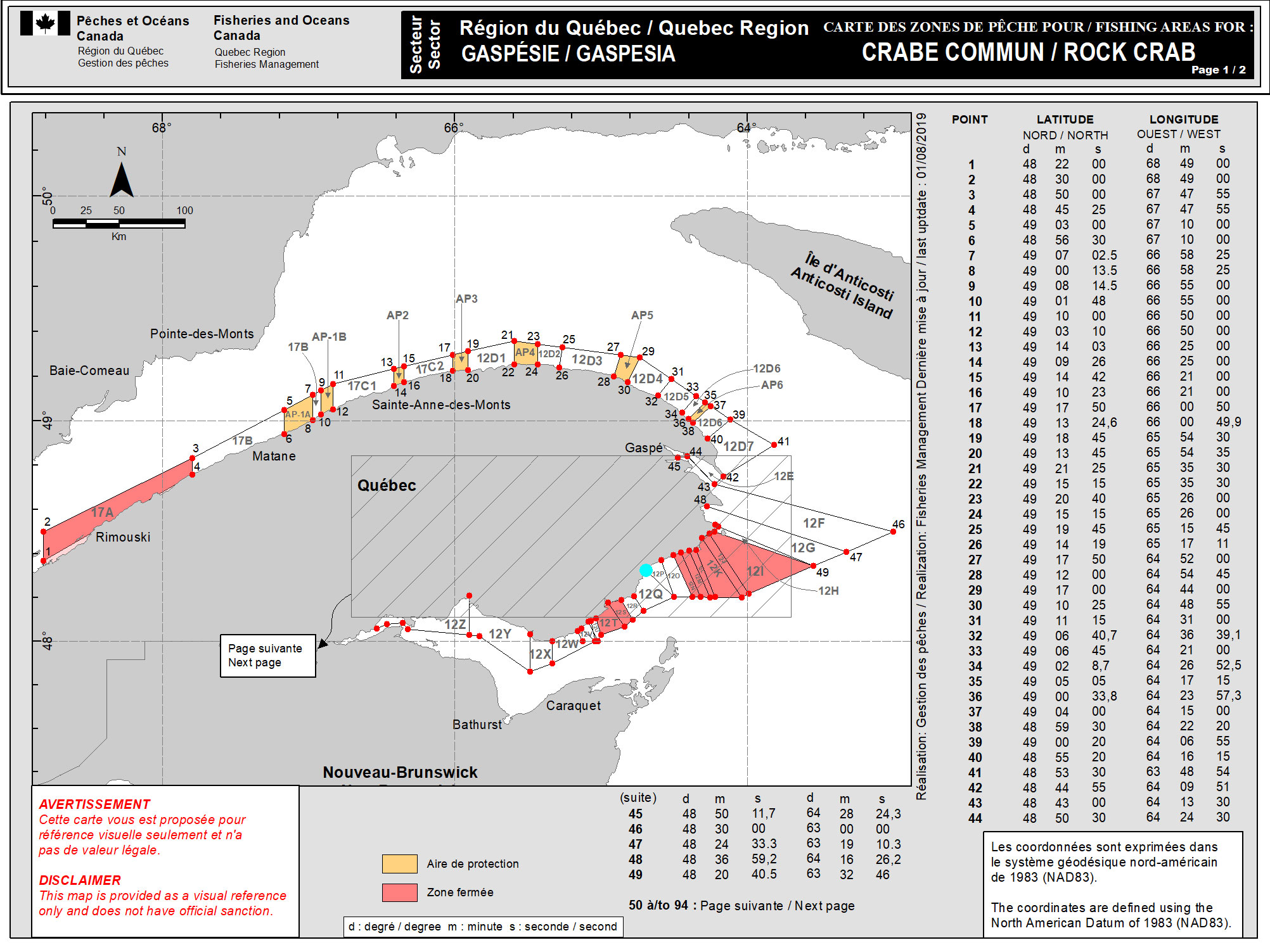
3.4 Closed areas of the Gaspesie – Lower St. Lawrence area
It is prohibited to fish for rock crab in closed areas 17A, 12I through 12N, 12S, and 12T, as well as in protection areas AP-1A, AP-1B, and AP 2 through 6, which are identified on the Gaspesie – Lower St. Lawrence map.
-
Fishing Seasons
- For the Magdalen Islands area, sub-areas 12A, 12B, and 12C, the fishing season dates, are fixed from August 21 to December 31. The season lasts for a maximum of 19 weeks.
- For the Gaspesie – Lower St. Lawrence area, sub-areas 12D to 12Z and 17C, the dates are set annually. The fishing season typically runs from late July to late September. The season lasts for a maximum of 8 weeks.
- For the North Shore area, sub-areas 16A to 16G, the fishing season dates, are fixed from July 31 to November 26. The season lasts for a maximum of 17 weeks.
The fishing seasons set forth in this section are in effect for the duration of this CHP. They represent the maximum fishing periods, subject, among other things, to Variation orders and specific closure periods. Thus, opening dates may vary depending on particular circumstances and fisheries management considerations, including industry requests and the announcement of TACs, while closures may be advanced, notably when quotas are reached or when there is a high probability of exceeding them. The specific periods will be confirmed by Notices to Fish Harvesters or Variation Orders.
Furthermore, it should be noted that during the period when fishing is authorized, it is the captain’s responsibility to acquaint himself with the marine safety notices published by Environment and Climate Change Canada and Transport Canada, as well as with the standards and best practices in marine safety, and to take all necessary measures to ensure safe fishing operations.
-
Number of licences and access
At the time of publication of this CHP, the number of licences is as follows:
- Magdalen Islands: 12 licences
- Gaspesie – Lower St. Lawrence: 31 licences
- North Shore: 8 licences distributed as follows:
-
Management regimes and quotas
In Quebec, the rock crab is fished under three different management regimes:
- Individual transferable quotas (ITQ): A total annual allocation is distributed from an administrative list among licence holders of the designated sub-areas. Certain terms and conditions are specified in sub-sections 6.1 and 6.2.
- 12A, 12B et 12C (MI): 375.746 tons
- 16B (NS): 72 tons (36 tons per sub-area)
- Individual Quotas(IQ): A total annual allocation is distributed from an administrative list among licence holders of the designated sub-areas, and the quantities are non-transferable. Certain terms and conditions are specified in sub-section 6.2.
-
- 12D4 to 12D7 (GLSL) : 148.5 tons
- Competitive regime with total allowable catch (TAC): A maximum annual quota is available for fishing by all licence holders in the identified subzones. Certain terms and conditions are specified in sub-section 6.2.
Gaspesie – Lower St. Lawrence:
-
- 12D1 à 12D3 et 17C: 75 tons
- 12E à 12O: 81.5 tons
- 12Q, 12W et 12X: 77.5 tons
- 12Y: 61.5 tons
- 12Z: 101.5 tons
North Shore :
-
- 16D: 31 tons
6.1 Administrative guidelines of the ITQ programs
Administrative guidelines of the ITQ program of sub-area 16B are included in the Regional guideline for the management of individual transferable quota programs, which is available on the DFO Quebec Region website.
Administrative guidelines of the ITQ program of sub-areas 12A, 12B and 12C are available through DFO Magdalen Islands area’s office.
6.2 Quota Reconciliation
Individual transferable quota (ITQ) and Individual quota (IQ): Any individual quota overrun incurred by a licence holder during a season will be deducted, on a one-to-one ratio, from the licence holder’s individual quota for the following season. It is the responsibility of licence holders to monitor their quotas to ensure that catches made during their fishing activities do not exceed their allocated quotas. Licence holders will be notified of the reconciliation of their individual quota via an appendix or information note attached to their Conditions of Licence.
Competitive quota: Any overharvest of a sub-area’s quota incurred by the fleet during a season will be deducted, on a one-to-one ratio, from the sub-area’s competitive quota of the following year.
-
Catch management
7.1 Characteristics of authorized catches
Only male rock crabs with a carapace width of 102 mm or more may be retained. All female rock crabs and all male rock crabs with a carapace width of less than 102 mm must be immediately released back into the water.
7.2 Discarding incidental catches
No bycatch may be retained during fishing activities targeting the rock crab. All bycatch must be released immediately. Notwithstanding the foregoing, bycatch of spider crab in sub-areas 12D1 through 12Z and 17C may be retained, and bycatch of lobster must be counted, recorded in the logbook, and then released back into the water without delay.
When releasing a live fish, the licence holder must return it immediately to the water from which it was caught, taking care to cause it as little harm as possible.
-
Fishing Gear
8.1 Number of authorized fishing gear
Licence holders are authorized to use the number of traps indicated on their licence or in their Conditions of licence. The maximum number of traps allowed is :
Magdalen Islands:
- 85 traps 4 feet in diameter; or
- 140 traps 3 feet in diameter.
Starting with the 2026 fishing season, the use of a single type of trap will be mandatory in sub-areas 12A, 12B, and 12C. It will no longer be possible to alternate between 3’ and 4’ traps, even based on the equivalence established in the past. The number of traps authorized must now correspond exclusively to a single, selected trap type.
Gaspesie – Lower St. Lawrence:
- Sub-areas 12D1 to 12D7, 12F to 12Q, 12X and 17C: 150 traps
- Sub-area 12W: 100 traps
- Sub-areas 12Y and 12Z: 75 traps
North Shore:
- Sub-area 16B (excluding 16B-1): 200 traps
- Sub-area 16B-1 and 16D: 150 traps
8.2 Characteristics of fishing gear
Traps must comply with the following dimensions:
Magdalen Islands:
- Type 1:
- Height: Min. 381 mm – Max. 508 mm
- Lower diameter: Max. 914 mm
- Upper diameter: Min. 457 mm
- Type 2:
- Height: Min. 508 mm – Max. 677 mm
- Lower diameter: Max. 1,219 mm
- Upper diameter: Min. 609 mm
Gaspesie – Lower St. Lawrence and North Shore:
-
- Height: Min. 381 mm – Max. 508 mm
- Lower diameter: Max. 914 mm
- Upper diameter: Min. 457 mm
Release mechanism:
It is prohibited to use for fishing, or to have on board a boat, a rock crab trap unless it is equipped with an escape mechanism consisting of at least 4 unobstructed circular openings with a diameter of not less than 65 mm, and where the bottom of the openings is located at a distance from the base of the trap that does not exceed 51 mm.
Biodegradable mechanism:
Magdalen Islands, sub-areas 12A, 12B, and 12C :
Starting with fishing season 2027, a biodegradable release mechanism will be required on traps. The use of cotton thread or iron links will be permitted.
Requirements regarding ropes among other things, are set forth in the Conditions of licence, where applicable.
8.3 Hauling and soaking duration
It is the licence holders' or their operators' responsibility to haul in their fishing gear at least every 72 hours.
For sub-areas 12D1 through 12Z and 17C, it is prohibited to pick up and bait traps more than once a day. Moreover, traps may not be picked up during the two days following the opening date of the fishery.
8.4 Identification of the fishing gear
All traps used for fishing must bear a single valid annual tag bearing a unique identification number.
Fishermen must obtain their tags from suppliers approved by the Department of Fisheries and Oceans (DFO).
The minimum requirements regarding the number and placement of colored markings on fishing ropes are detailed in the Conditions of licence. Information is available in the Notice to Fish Harversters of August 14, 2020.
It is prohibited to have unmarked fishing gear on board a fishing vessel. In addition to the regulatory requirement to mark buoys with the vessel registration number (VRN), licence holders must add a sequential number to each main buoy in order to be able to individually identify each fishing gear.
8.5 Requirement to report lost and retrieved gear
The licence holder and fishing vessel operator must report any loss or recovery of fishing gear. Reports regarding the loss or recovery of gear must be submitted to DFO through the online Fishing Gear Reporting System or by completing and submitting the Lost Fishing Gear Form or the Retrieval of previously reported lost fishing gear form, wich are avaiblable online and attached to the Conditions of licence.
Licence holders and fishing vessel operators must provide information regarding all interactions with a marine mammal that occur during fishing expeditions in accordance with the Conditions of Licence. To do so, the licence holder and fishing vessel operator must complete the section reserved for that purpose in his ELOG or the marine mammal interaction form available on the Report a marine mammal or sea turtle incident or sighting page and attached to the Conditions of licence, and it must be submitted as per the instructions provided on the form.
In addition, if you observe a dead or distressed animal, please contact Marine Mammal Emergencies as soon as possible at 1-877-722-5346. If possible, do not hesitate to take photos or videos that will allow DFO to assess the situation and identify the species.
-
Fishing activities declaration and monitoring
10.1 Hail-out
Not applicable.
10.2 At-sea observer
Not applicable.
10.3 Logbook
Licence holders and fishing vessel operators must maintain an accurate record of their fishing activities and catches in their Combined Form or Electronic Logbook in accordance with their Conditions of Licence.
10.3.1 Combined form / logbook
Licence holders must obtain their Combined Forms booklet from suppliers prequalified by DFO.
The Logbook section of the Combined Form must be completed each day of fishing and returned to DFO.
10.3.2 Electronic logbook
The use of an electronic logbook (Elog) is optional until further notice. Fish harvesters must use a client application approved by Fisheries and Oceans Canada for the Quebec region for the form ELOG - Crabs. Furthermore, fish harvesters must have obtained and installed their Elog Key in their client application in order to allow data transmission to the Department
The Elog must be completed for each fishing expedition and “closed” before arriving at port. A fishing expedition means a voyage that commences at the time a fishing vessel leaves a port to engage in fishing and terminates at the time fish caught during that period are offloaded. Hence, when a fish harvester goes back to port for a reason other than for offloading fish and leaves port again, the fishing expedition goes on until fish are offloaded.
To consult the list of client applications approved by the Department and to obtain your Elog Key, visit Fisheries and Ocean’s web page at the following address: Electronic logbooks (ELOGs)
To request a modification to data that has been transmitted to Fisheries and Oceans, you must communicate with the client support service at 1-877-535-7307.
10.4 Hail in
Sub-areas 12A to 12Z, 16A, 16D and 17C : It is mandatory to hail in to a qualified local dockside monitoring company accredited by DFO in accordance with the terms and conditions set forth in the Conditions of licence.
10.5 Dockside Monitoring
Sub-areas 12A, 12B and 12C:
Dockside monitoring is mandatory, with a target rate of 100% starting in 2026.
Landings must be made at one of the ports listed on the Designated Dockside Monitoring Ports List.
Your unique Electronic Logbook identifier (ULB-ID) must be provided to the dockside monitoring company when you make your hail-in call and must also be provided to the dockside observer.
Sub-areas 12D1 through 12Z, 16, and 17C:
There are no requirements regarding dockside monitoring.
-
Vessel monitoring system (VMS)
Not Applicable
-
Specific provisions applicable to the fishery
12.1 Vessel
Fish harvesters may use a vessel with an overall length less than 15.24 m (50 feet).
12.2 Buddy-up
Not applicable.
12.3 Participation Clause
Holders of exploratory licences for rock crab fishing in Sub-area 16D and fishing vessel operators must demonstrate that they have fully participated in the development of the fishery by meeting predetermined minimum annual participation criteria before being eligible for licence renewal, if applicable.
The minimum annual participation criteria are:
- Completion of a minimum of three (3) fishing expeditions during the fishing season, excluding the expedition to set the traps. A minimum of 50 traps must be hauled in on each fishing expedition;
- Collection of data in accordance with the sampling protocol provided by Fisheries and Oceans Canada; and
- Submission of sampling data, recorded on the provided paper and electronic forms, to your Fisheries and Oceans Canada area office each year, no later than the date specified in the Conditions of licence.
Participation criteria may be adjusted, and additional criteria may be added, should the licences be reissued the following year.
If a licence holder fails to meet the predetermined participation criteria during a given year, the exploratory fishing licence may not be reissued the following year.
12.4 Simultaneous Fisheries
It is prohibited to fish simultaneously for rock crab and any other species that are fished with traps.
Notwithstanding the preceding paragraph, the simultaneous fishing of the rock crab and the whelk is permitted during separate fishing trips in Sub-areas 16B and 16D.
-
Species At Risk Act
Pursuant to the Species at Risk Act, no person shall kill, harm, harass, capture, take, possess, collect, buy, sell or trade an individual or any part or derivate of a wildlife species designated as extirpated, endangered or threatened.
All incidental captures of species at risk must be immediately returned to the water where they were captured and, if the animal is still alive, in the manner that causes it the least harm. All incidental captures of species at risk must be recorded in the ”Species at Risk” section of the logbook. Furthermore, all interactions with species at risk, notably the North Atlantic Right Whale, the Blue Whale (Atlantic population) and the Beluga Whale (St. Lawrence Estuary population), must be recorded in this section of the logbook.
These requirements are additional to any obligation to declare an interaction with a marine mammal using the prescribed form (see section 9 - Marine Mammal Interaction Reporting).
-
Crew Registry
All independent core licence holder and their approved substitute designated operators must keep records of all the crew members working aboard the vessel on every fishing expedition in accordance with their Conditions of licence. This requirement does not apply to pre-1979 corporation licence holders, midshore licence holders nor to any holder of a licence issued under the authority of the Aboriginal Communal Fishing Licences Regulations. For further details, refer to the March 17th, 2021 Notice to fish harvesters, New inshore regulations or contact the Customer support at 1-877-535-7307 or fishing-peche@dfo-mpo.gc.ca.
-
Discharge of Waste
The licence holder and fishing vessel operator are prohibited from discarding in Canadian fisheries waters from their vessel any item that may be harmful to fish or fish habitat. Please refer to the following Notice to Fish harvesters : New condition of licence relating to discharge of garbage.
-
Conditions of Licence
To obtain their Conditions of licence, fish harvesters must access the National Online Licensing System. For National Online Licensing System assistance, please contact customer support by phone at 1-877‑535-7307 or by email at fishing-peche@dfo-mpo.gc.ca.
Note: In the event of a discrepancy between the French and English versions of the CHP, the French version shall prevail.
Approved by:
Anne Lagacé
Interim Regional Director General
Fisheries and Oceans Canada
Quebec
For any question regarding this CHP, please contact:
Magdalen Islands Area: 418-986-2095
North Shore Area : 1-800-463-1729
Gaspe - Lower St. Lawrence Area : 1-877-898-5559
For additional information
Please visit the Fisheries page of our website (dfo-mpo.gc.ca).